
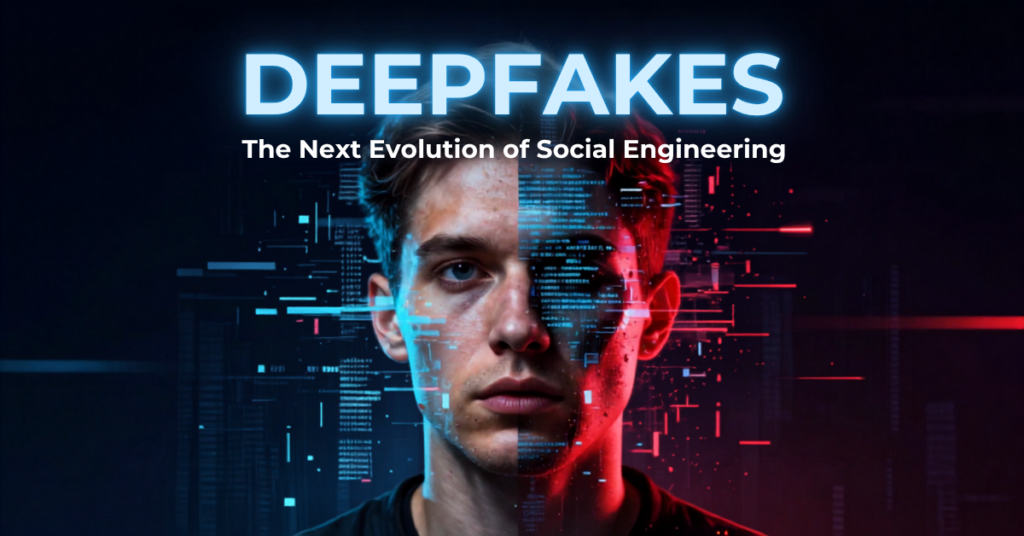
Cybercriminals have always relied on deception. What has changed is the sophistication of the tools available to them. Artificial intelligence now enables attackers to create convincing fake voices, images, videos, and digital identities at unprecedented scale.
Deepfake technology has emerged as one of the fastest-growing cybersecurity threats of 2026.
Traditional phishing attacks often contain obvious warning signs. Poor grammar, suspicious links, and unusual requests frequently reveal malicious intent. Deepfake-enabled attacks remove many of these indicators by creating highly realistic communications that appear authentic.
Attackers can now generate synthetic audio that mimics the voice of an executive, manager, or trusted colleague. Employees may receive a phone call that sounds identical to their chief executive officer instructing them to approve a payment or share sensitive information. In some cases, video conferencing technology has been manipulated to create realistic visual impersonations.
The rise of publicly available AI tools has dramatically lowered the barrier to entry. Criminals no longer need advanced technical expertise to create convincing synthetic media. A few publicly available recordings or images may provide enough material for a sophisticated impersonation attempt.
Financial fraud is one of the most immediate concerns. Organizations have already reported incidents involving deepfake audio used to authorize fraudulent transactions. As quality improves, detection becomes increasingly difficult.
Identity verification systems also face new challenges. Some authentication methods rely on facial recognition or voice recognition technologies. Deepfake capabilities raise questions about the reliability of these approaches when used in isolation.
The threat extends beyond businesses. Consumers face growing risks from impersonation scams, fake celebrity endorsements, manipulated videos, and misinformation campaigns. Trust in digital content is becoming harder to maintain.
Organizations are responding with layered defenses. Verification procedures for sensitive transactions are becoming more rigorous. Employees receive training focused on recognizing manipulation tactics and validating unusual requests through independent communication channels.
Technology solutions are evolving as well. Security vendors are developing tools designed to detect synthetic media, analyze behavioral patterns, and identify anomalies that indicate impersonation attempts. These technologies continue to improve, although attackers are advancing rapidly as well.
The broader lesson is clear. Trust can no longer depend solely on what people see or hear. Verification must become a standard part of digital interactions.
Deepfake technology represents a significant shift in cybercrime tactics. Social engineering remains one of the most effective attack methods because it targets human behavior rather than technical vulnerabilities. Artificial intelligence is making these attacks more convincing, more scalable, and more dangerous.
Organizations that strengthen verification processes today will be better prepared for the identity deception challenges of tomorrow.